Physics and math can help to point at solutions for the congestion the international supply chain faces today.
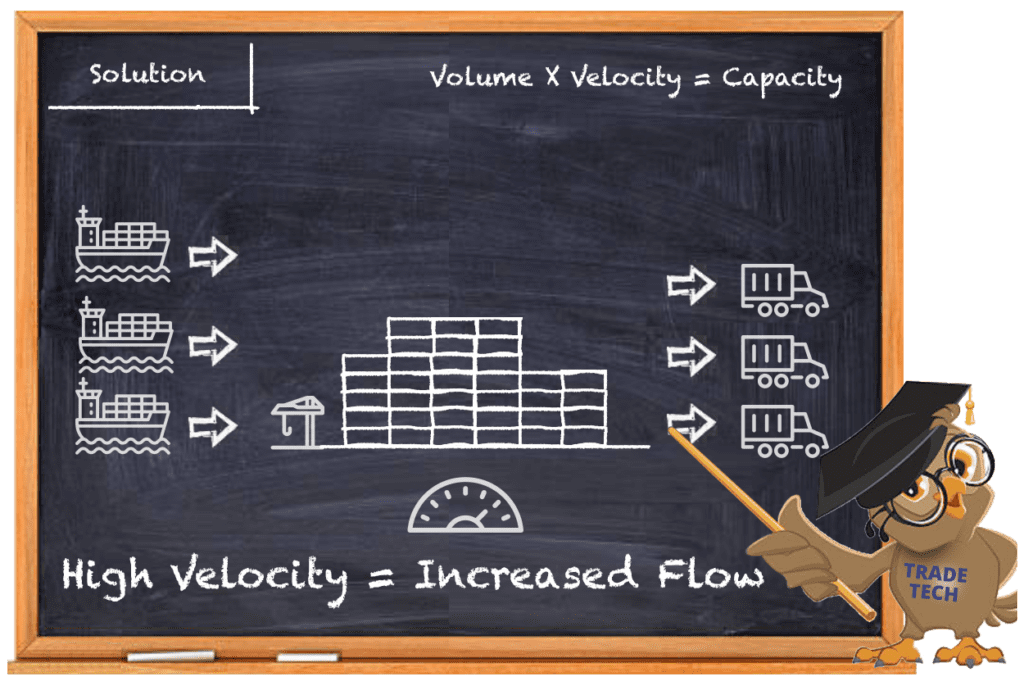
Capacity is a mathematic equation. Volume – the amount of something that an object can hold. Velocity is the speed at which volume moves through a given object. Overall capacity is volume x velocity. The international supply chain is facing this physics equation. The carriers have attempted to resolve the over demand issue by adding more volume but various bottlenecks have lessened the effect of their deployments. Recent statistics from several sources show that carrier capacity is actually down 30 – 35% despite all of the new ships brought into the trade because of the port congestion. This reduction in capacity comes from the fact that the ships are actually moving more SLOWLY than before because of the idle time when they arrive at the US Terminals.
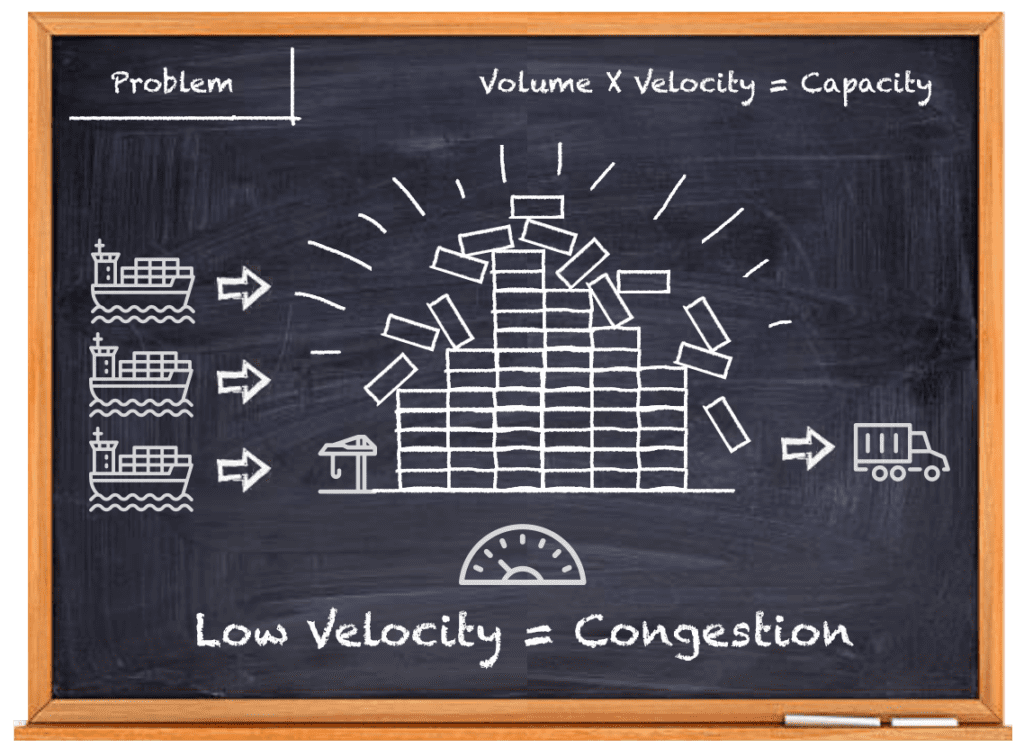
Terminal volumes are fixed as well. These are massive capital infrastructure complexes that are not easily or quickly expanded. However, the Ports of Los Angeles and Long Beach are stepping forward to convert their terminals to a 24 hour work day with three shifts of workers. That is a very positive step in the direction of velocity, speeding up the volume of cargo that can move through the terminals in a given day.
The issue right now is a delay in the market’s response to the terminals’ increase in appointment availability. Truckers and warehouses have been slow to respond, and the utilization of the new appointments is extremely low during the second shift and almost non-existent during the late night / early morning “Hoot-Owl” shift. Hopefully, free market forces will come into play shortly as truckers begin to realize that they can handle more loads in the evenings / nights when the lines are short and the roads are empty. More loads mean more money as they become impacted by velocity as well.
One can also expect that early movers in the market among the BCOs will offer premiums to truckers to handle their late night moves as they bring on extra warehouse workers to work the containers during evening shifts. Again, velocity will be the key to getting more flow of goods through the capital resources currently available. This involves significant changes in processes and procedures, but the end result will be a much smoother and capable supply chain.
Where does “Tech” come in? Data is an essential part of the velocity equation. This won’t be the first time that the carriers have sped up their velocity only to find that the BCO community needed to respond with a corresponding adjustment to it’s own processes and procedures in order to take advantage of the changes the carriers had made. Back in the early 1980’s, the carriers shifted their schedules and introduced faster ships, reducing the transit time from Europe to the US East Coast to only nine (9) days. This looked great on paper but in reality the BCOs, Banks, and Customs House Brokers couldn’t work that quickly in the existing paradigm. Nine (9) days was faster than the documents could get to from origin to destination. Thus, the adage “The cargo can only move as fast as the documents” was coined. This led to new changes in processes and procedures and the “Telex Release” and “Express Bill of Lading” were created so that the banks didn’t slow down the process.
Increased velocity will mean more appointment scheduling, more pick-up orders, and more issues that need to be resolved. This is again where Terminal Communities can accelerate the business process and facilitate the velocity needed to achieve increased capacity. Here are four ideas:
1) Allow and facilitate warehouse operators to set the appointment slots for the containers they want to handle in the order they want to handle them.
2) The supply chain operator selects the trucker and then allows and facilitates the truckers to come online and see the appointments and respond to them. This accelerates the communication between the truckers and warehouses and ties them both into the port and / or rail terminals appointment system.
3) Provide customer service and supply chain management from offshore to handle problem resolutions. Off-shore interactions are not new in this day and age. Remember, we are all together when we are on-line. The key is that offshore staff would have real time visibility to the same information that the trucker and warehouse operators have and would have the tools and authority to provide any customer service required.
4) Lastly, allow for automation within the TMS process. Load up the system with approved truckers based on locations and / or customers and let the system assign and respond to truckers until all of the appointments have been confirmed. This is truly where automation can work far more quickly than a human but allowing for the human logistics expert to make decisions about carrier selection on a higher level rather than on a load-by-load basis. This would be very similar to what Convoy and other software providers are doing for long haul trucking.
They key is to facilitate parties to come together in a common platform with agreed upon rules, controls, and visibility. This will allow the data to move more quickly and that, in turn will accelerate the supply chain and help to achieve the needed increase in overall capacity that the industry demands.